|
|
|
| Main : Journal : Service : Motherland : Coordinates |
|
Chuvashia |
|
Chuvash Republic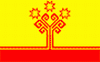
Do you know such a nation Peder Khuzangay 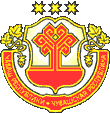
|
The Chuvash History and Language
 Many people know about the Chuvash Republic thanks to the well-known ballerina Nadezhda Pavlova and astronaut Andrian Nickolaev.
Chuvashia occupies a singular place in the middle of Russia, where Slavonic, Finno-Ugric and Turkic peoples of Orthodox and Moslem religions lived side by side in peace and harmony since old times.
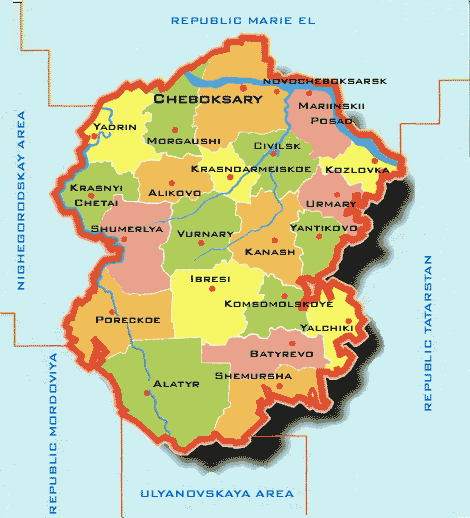
The territory of the Chuvash Republic can be compared with that of Albania in Europe, Swaziland in Africa and Kuwait in Asia. It spreads for 190 km from the south to the north and for 160 km from the west to the east.
The republic is situated in the middle part of the Volga region and in the centre of the European part of Russia. The comparatively small territory (18.3 thousand square km) is inhabited by 1 million 400 thousand people, with 40% of the population living in the countryside.
According to the density of the population the republic takes the 4th place in Russia. The Chuvash people is the 4th among other native peoples of Russia in overall numbers. All in all 906,900 Chuvashes (ive 49.2% of all numbers) live in our republic. The rest of them live compactly in the regions bordering on the republic.
The national structure of the republic is represented by Chuvash - 67.8%, Russian - 26.7%, Tatar - 2.7%, Mordva - 1.4%, representatives of 60 other nationalities - 1.4%.
The political situation in the republic as well as the relations between the nationalities are stable.  " There is no future for the people, who forget their past", says one of the Chuvash proverbs. The Chuvash people remember their past well. They call their ancient land "the land of Ulips"-after the fantastic heroes of the national epic, who were remarkably strong and kind and hardworking...
The Turkic ancestors of the Chuvash - Bulgar and Suvar seminomadic tribes - lived in Central Asia in ancient times, on the territory between the Tyan-Shan and Altai, in the Irtish river-basin. At the beginning of our era the Bulgar and Suvar tribes separated from the rest of the Turkic tribes and started to move to the west - because of a sudden drought.
In the II - III centuries they settled in the North Caucasus where they lived for 5 centuries. In the VII century in the Asov region there was formed great Bulgaria which included the Suvar tribes. After their land had been conquered by Arabs they moved to the middle part of the Volga River.
Already in the X century the Suvars were called "the Suvases". Their nearest neighbours, the Mari, called them "Suases". The name "Chuvash" comes from "Suvas"
Both Bulgarians and Suvars spoke the language similar to Chuvash: instead of "z", heard in other Turkic languages, they used the sound "r" (rhotacism), instead of "sh" - "1" (lambdaism)
The Chuvash language in the Volga Bulgaria was the state language, it has considerably influenced on the languages of the constituent peoples. The Mari language acquired 1,500, - more than 500, Komi-Permyak - more than 100, Hungarian - about 600 Chuvash
The invasion of Tatars & Mongols in 1236 destroyed the blooming land. The Chuvash, pagan by nature, hid themselves in the woods to avoid compulsion to Islam. During this tragic period they lost their written language and much of the rich Bulgar heritage. So the formation of the Chuvash into a single nation was going on the base of the rural Bulgarian population who did not adopt Islam and it was completed on the boundary of the XVth-XVIth centuries.
In 1551 the "mountain people" (so they called Chuvash in Russia) in order to preserve their national character and to avoid destructive feudal wars volunteered to join the Russian state. The conversion to Christianity which took place at the same time was an especially significant event in the history of the Chuvash people; it played a progressive role in the development of the Chuvash ethnos. For the past five centuries the Chuvash nation, having begun to live in peace,
not only preserved itself as a nationality, but increased ten times, created the written language and statehood.
Now, a few quotations, in chronological order:" Chuvash is a primitive language. The dictionary lying in front of me on my desk has only 1,646 words, and if you count only the roots there are not even a thousand words. Incidentally, let me say here that an uneducated people who do not have abstract ideas cannot, naturally, have names for such". (Written by A. Fuks, folklorist, in 1840)
"They (the Chuvashes) will completely forget both their language and their way of life, particularly since the elements of this life, besides being bleak as such, do not have the slightest connection either with the present religion or with their historic memories. (V.Sboyev, ethnographer, 1856)
"Books in Chuvash merely foment a separatist spirit and a self-conceit which is as distasteful as it is harmful... There never was, and never will be, a Chuvash culture. (A.Melnikov, Chairman of the Gubernia Land Council, 1903)
After the formation of the Chuvash autonomous republic in 1920 scores of books and hundreds of articles have been written about the Chuvash language and about the rich folklore
and distinctive culture of the Chuvash people.
Today, nearly 90% of the adults speak Chuvash in the home, 80 % speak it at work, and 85%
sing Chuvash songs.
Those are some of the findings of a survey carried out by workers of the Chuvash Scientific Research Institute to elucidate the part the Chuvash and Russian languages play in the life of the rural inhabitants, who comprise the bulk of the population of the Chuvash Republic. They interviewed several thousand adults in a number of villages of all types, some near towns and main roads and others deep in the hinterland. All of them watch TV programmes in both languages.
To the Chuvashes, as to the other peoples of Russia, Russian has become the language of communication and co-operation with the country's other nationalities, and also a language gives them access to the world's finest cultural achievements.
Here, as everywhere else in this multinational country of ours, free development < local language is guaranteed; every citizen has complete freedom to speak any language, to use it in bringing up and teaching his children, no privileges, restrictions of compulsion regarding the use of any language are practised nowadays.
According to the "Law about Languages", adopted in 1990, two languages, Chuvash and Russian, are declared to be state ones in the Chuvash Republic.
From this year the Chuvash language should be studied in all kinds of educational institutions of the republic beginning from the first form of secondary schools and including technical and vocational secondary schools, institutes and universities. |
Though some Russian parents do not want their children to study the Chuvash language, it is a must. We can see signs in two languages, in the local and in Russian, at the bus, trolley-bus stops, shops, cinemas and department stores. Divine service in the majority of churches is held both in Chuvash and Russian.
The Chuvash language is developing on a basis of equality and mutual enrichment, in conditions of fraternal friendship and mutual trust. It is flourishing and enjoys universal recognition.
There is ample scope for the use of both Chuvash and Russian, and to all practical intents and purposes the Chuvashes have become bilingual. The attachment which the Chuvash people feel for the Russian language is even stronger in the towns than in the villages, especially in the sphere of work and study. If you have a walk around Cheboksary - the capital of our republic -you can everywhere hear the Chuvash speech as well as the Russian one.
According to the data of the 1989 general census of the population, from all the Chuvashes living on the territory of the former USSR, almost one fourth of them didn't name the Chuvash language as their native one. Even in the Chuvash republic itself the quota of aborigines, who could not speak their native language, reduced for about 15%.
Now a few facts from its history. The Chuvash language refers to the Bulgar subgroup < the Turkic group of the Altai family of languages. It is interesting to note that it preserved the elements close to ancient Mongolian and Finno-Ugric; Persian and Arabic words can also be found in it.
There is a curious Chuvash saying that a cow ate a Chuvash book. It is curious because until a little over a hundred years ago the Chuvashes did not have an alphabet. Or could they have had an alphabet and then lost it somehow? How, otherwise, did words like vula - read, syir - write, syiru - letter and syirulikh - alphabet, get into the Chuvash language? Where did the Chuvash needlewomen get the expression syiru terri - alphabetical embroidery? Chuvash scholars have discovered that the people once used ideograms, then runes and later Arabic characters. But the long period of Tatar - Mongol rule and the suppression of Chuvash culture led to the disappearance of the alphabet. In the XVIII and XIX centuries several religious books were translated from Russian into Chuvash, with the use of Russian characters. However, there was no written language.
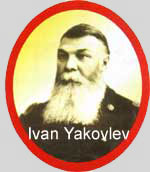 A young Chuvash schoolteacher named Ivan Yakovlev, who founded the first Chuvash school in the small town of Simbirsk (now Ulyanovsk) on the Volga River, set out to invent one. Champions of rebirth of the native word studied at the Simbirsk Chuvash School at that time. The famous national poet Constantine Ivanov was one of the outstanding students of I. Yakovlev. In 1871 Ivan Yakovlev devised an alphabet used nowadays which took the phonetic, morphological and syntactical features of the Chuvash language into account. The following year he published his "Chuvash ABC". After that the first books in Chuvash began to appear.
After abolition of serfdom school education was improved noticeably. In 1870, it was allowed to conduct preaches in churches and primary education in schools in the Chuvash language.
In 1897, 7.5 per cent Chuvashes were literate. More than 700 books were published in the native language. K. Ivanov's poem "Narspi", published in 1908 with the assistance of his teacher I .Yakovlev, became a peculiar complection of the entire prewritten period of the development of Chuvash word. This poem, written by K. Ivanov at the age of 17, is a classic model of Chuvash literature. The poet gave a lasting life to native word in his following works, using an aching sadness of national songs and wisdom of tales, reflecting a non-bright beauty of nature.
But just an alphabet in itself was not enough. The people had to be given an opportunity to use it. It was necessary to wipe out illiteracy, create conditions for cultural progress of the people and for their free development as a nationality. All this was done after the formation of the Chuvash Republic in 1920. Since then instruction in Chuvash schools and also court and legal proceedings were being conducted in Chuvash, facilities were being provided for postal, telephone and telegraphic communications in Chuvash on the territory of the region. Before 1920 this language was suppressed in Russia.
But in the 30-s, some ten or more years after the formation of the republic, the situation sharply changed for the worse. The article about the state status of the native language was struck off the Constitution of the republic. The schools went over to instruction in the Russian language. They abandoned teaching Chuvash even as a subject. Newspapers and magazines which had been published in the places of compact residence of Chuvashes outside the republic were suppressed. Fortunately, this suppression did not last long.
In spite of the close relations with the Russian people and among themselves, the peoples of the Volga region preserved the specific features of their culture though they experienced certain mutual influence. The centuries-old close ties with the Russian culture promoted the penetration of Russian and international words into the Chuvash language.
As we can see, the Chuvash language is much older than the Chuvash ethnos. As for its peculiarities, the predominance of voiceless noisy consonants and powerful degree of consonant palatalization is marked in the Chuvash language which is also rich in long (double) consonants.
There are a number of different accents and 2 main dialects - the lower (anatri) and the upper (viryal) ones in this language. The dialects slightly differ from each other in phonetic, morphological, syntactical and lexical meaning of the words.
The study of the native people's linguistic riches is coordinated by the Chuvash Research Institute by which an atlas of native dialects has been compiled.
The Chuvash State University as well as the Teachers' Training College has faculties history and philology, at which teachers of the Chuvash language and literature are trained. Carrying on the traditions of Ashmarin, who was the author of the 17-volume dictionary Chuvash language, Yegorov, Gorsky and Sirotkin, those distinguished scholars at the native language and literature, professors and assistant professors of the Department of Chuvash Philology conduct research and compile textbooks for the students. These include "A History of the Chuvash Language" and "The Modern Chuvash Literature". Chuvash - Russian and Russian - Chuvash dictionaries are also compiled.
The Chuvash land is rightfully called the land of a hundred thousand songs and embroideries. To preserve the national traditions the Chuvash people guard lovingly their folklore and handicraft. The bright Chuvash dances and sweet melodies of their songs touch the hearts of those who happen to see or hear them. Natasha Vasilieva |
| Main : Journal : Service : Motherland : Coordinates |